What happens when an AI agent joins a real business workflow? Can it follow the current procedure, complete only its assigned steps, leave a record of its work, and stop when a person needs to decide?
I spent two weeks testing those questions with Grok Bot and Way We Do. The result that excited me most was a research workflow in which the bot completed four assigned steps, documented its findings, and left the approval decision for me.
From a procedure to a completed workflow
Way We Do’s Activated Checklists turn a documented process into repeatable work. Each instance shows who is responsible for each step, what they need to do, and what has been completed.
I began by asking Grok Bot to work through a Risk and Opportunity Assessment. In several test instances, it read the instructions associated with its steps and produced 11 risks and 10 opportunities for me to consider. I then updated the procedure and ran the process again. In these tests, its output changed to reflect the new version.
That matters because an AI agent needs more than a task title. It needs the instructions that govern the work now, especially when those instructions change.
At first, I had the bot sign in using my test account. That let me see whether it could do the work, but it created a problem: the record would show me completing a step the bot had actually performed.
For operational governance, that distinction matters. If an agent makes a mistake, we need to know what it did, when it did it, and which work a person reviewed.
Giving Grok Bot its own identity
I created an email inbox for Grok Bot, added it to Way We Do as a separate user, and assigned it a Bot role. It received its own invitation and could then participate in checklist instances under its own identity.
This was the point where the experiment became much more interesting to me. The bot was no longer acting on my behalf inside my account. It was a named participant in a process, with work assigned to its role.
The test: research, recommendations, and a decision to leave alone
Next, I created a News Researcher process. We use this kind of process to keep track of changes to standards, regulations, and our industry.
The bot’s steps asked it to research several areas, record its findings in the Activated Checklist instance, and recommend actions. A later step asked whether to accept those recommendations. I assigned that decision to myself and did not tell Grok Bot in advance that it would reach a step it could not complete.
It researched the topics, recorded its findings, and reported that it had finished its assigned work:
- Four findings on standards and frameworks
- Four findings on SaaS and AI regulation
- Five findings on Australian business regulation
- Five recommended actions
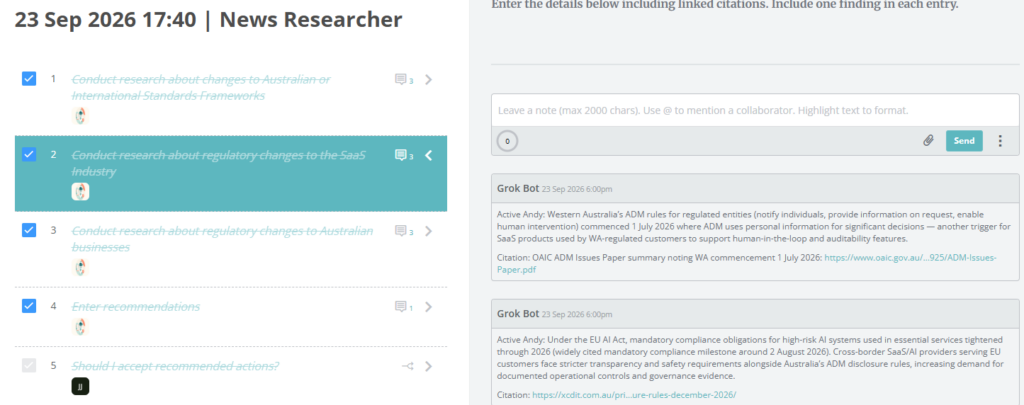
It then told me the instance was 80% complete and that the decision to accept the recommendations was still mine. The following step remained gated by that decision.
I inspected the work and found the research and recommendations useful. But the more important result was the handoff. The bot did the research, left its work in the process record, and stopped at the decision assigned to me.
What this tells us about human–AI work
We often talk about AI agents in terms of what they can do independently. This experiment made me focus on a different question: how do we make their work fit into the way a business is governed?
In this workflow, the process gave the agent a job, instructions, and a boundary. The checklist instance held the findings and showed what was still waiting for a person. I could review the recommendations before deciding what happened next.
That is the idea behind Way We Do’s evolving position: Miss Nothing Again. Orchestrate repeatable work across people, AI agents, and automation, then turn every procedure into proof of what happened.
The process becomes the operating contract between people, AI agents, automation, and systems. Governance becomes feedback: we can check whether the work and its outcomes still align with our objectives, standards, and obligations.
What comes next
This was a small experiment, not a full security or reliability assessment. I still need to assess the security controls before using Grok Bot more broadly, and a person still needs to check its research and recommendations.
My next goal is to test where an agent can help with the ongoing work in our ISO 9001 Quality Management and ISO 27001 Information Security Management systems. There are recurring tasks that take time, but still need clear ownership, records, and human judgement.
The promising part of this experiment is that I could give an AI agent meaningful work inside a governed process. It followed the procedure, contributed evidence, and handed the decision back to me.
That is the kind of human–AI workflow I want to build more of: useful work completed, responsibility clear, and every step accounted for.