Every growing business reaches a point where work becomes too important to leave in someone’s head.
At the beginning, the founder knows how everything works. A small team learns by watching, asking questions, and figuring things out as they go. But as the business grows, that informal way of working starts to break down.
Clients expect consistency. Team members need training. Managers need visibility. Compliance requirements increase. And now, work is no longer completed by people alone.
Increasingly, work is being completed by a combination of people, AI, and robotic process automation, also known as RPA.
That creates enormous opportunities for speed, scale, and efficiency. But it also creates a serious question:
How do you make sure people, AI, and automation all follow the right process?
That is where Way We Do comes in.
Way We Do helps growing businesses capture how work is done and turn it into active workflows that guide people, AI, and automation step by step. And with Way We Do Capture, getting started is simple.
You walk through the work.
You talk through what happens.
Way We Do Capture turns it into a documented process.
Walk. Talk. Done.
The hidden cost of business chaos
Every business pays for chaos.
It shows up as lost clients from inconsistent service. It appears as team burnout from constant overload. It becomes bloated costs from repeated mistakes. And it wastes the owner’s time as they step in to fix avoidable errors instead of focusing on growth.
When processes are unclear, people guess. When people guess, outcomes vary. And when AI or automation is added to a messy workflow, the problem does not disappear.
It simply automates the mess and speeds up the mistakes.
That is why the issue is rarely a “people problem”. More often, it is a standards problem.
Without clear standards, no one knows exactly what good looks like. Team members are unsure what must happen next. AI lacks the right context. Automation moves information, but may move it at the wrong time, to the wrong place, or without the right checks.
In a modern business, clarity is not optional. It is the foundation for safe, scalable growth.
Accountability is not micromanagement
Accountability is often misunderstood.
Some people hear the word and think of control, pressure, or micromanagement. But real accountability is not about hovering over people. It is about giving them clarity, support, and confidence.
It says: your work matters, so we are going to make sure you have the standard, structure, and tools to do it well.
This becomes even more important when people, AI, and RPA are working together.
Who checks the AI’s output?
Where does automation take over?
When does a human step back into the loop?
What must be approved, recorded, or reviewed?
Without accountability, everyone is guessing. With accountability, each part of the workflow has a clear role.
People manage relationships, judgement, exceptions, and oversight. AI can draft, summarize, recommend, and assist. RPA can move data between systems and complete repetitive tasks.
But the process must define how they work together.
Standards protect what matters
Standards do not make business boring. They protect what matters.
They protect your reputation.
They protect your client relationships.
They protect your team’s time.
They protect your revenue.
They protect your ability to scale.
A good standard defines what good looks like. It explains what must happen, who is responsible, what must be checked, and what evidence must be recorded.
For businesses looking to raise their standards, there are several pathways.
Some use international standards and frameworks, such as ISO, for quality, information security, health and safety, environmental management, or AI management. Others develop their own internal standards. Some choose third-party certification to validate their systems and help win larger contracts.
Regardless of the path, the foundation is the same.
You need clear standards.
You need documented processes.
You need evidence that work is being done correctly.
When those foundations are in place, standards become more than a compliance exercise. They become a business asset.
Operational maturity has commercial value
Operational maturity is not just about being organized. It has real commercial value.
When your processes are clear, your business becomes easier to train, easier to manage, easier to improve, and easier to scale.
You reduce dependency on a few key people. You reduce waste and rework. You make it easier to delegate. You make it safer to introduce technology. And you create intellectual property that belongs to the business, not just to the person who knows how to do the task.
This matters if you want to scale, franchise, win bigger contracts, improve compliance, or increase the overall value of your business.
AI needs context. Automation needs a clear path. People need clear expectations.
Standardization is not an expense. It is an investment in the way your business works.
From static policies to active workflows
Way We Do is an operational governance platform that turns static policies and procedures into active workflows for people, AI, and RPA.
Instead of having procedures sit in a folder, Way We Do helps businesses put those procedures into action.
Team members can follow step-by-step workflows. Responsibilities can be assigned. Due dates, approvals, and sign-offs can be built in. Evidence can be captured along the way. Audit trails are created as work is completed.
This matters because you cannot simply let AI and automation loose inside a business without structure.
A safe hybrid workforce needs governance.
It needs clear rules. Clear responsibilities. Human oversight. Defined handover points. And a record of what happened.
Way We Do provides the operational structure that helps people, AI, and automation work together safely and accountably.
But before a process can be governed, automated, improved, or trained, it first needs to be captured.
That is where Way We Do Capture changes the game.
The problem with traditional process documentation
For many businesses, process documentation is the bottleneck.
People know the work. They do it every day. But asking them to sit in front of a blank screen and write down every step is difficult, slow, and often frustrating.
Important details get missed. Decisions that feel obvious are not explained. Exceptions are forgotten. And the process often remains trapped in someone’s head.
Way We Do Capture removes that friction.
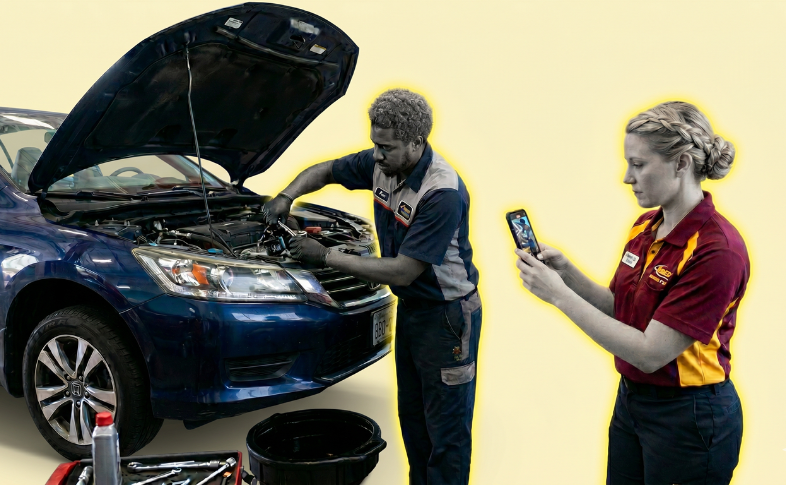
Instead of writing the process from memory, you record it while the work is actually being done.
It could be a physical process in a factory, workshop, clinic, warehouse, kitchen, or field environment. It could be a screen-based process completed online. It could be a routine task, a client workflow, an onboarding step, a quality check, or an internal administration process.
The person simply walks through the work, talks through what they are doing, explains their decisions, and shows the steps.
Way We Do Capture then extracts the useful information from the recording and turns it into a structured, step-by-step process ready for review.
Walk. Talk. Done.
The concept is simple.
Walk through the work.
Talk through what happens.
Done — the first version of the documented process is created.
Way We Do Capture can generate a process title, overview, step titles, instructions, images, and supporting detail from the uploaded video or audio. The reviewer can then check the content, adjust wording, select the right images, and confirm the process is accurate.
Once reviewed, the process can be created inside Way We Do as an Activated Checklist.
From there, it can be used as a workflow, reference guide, training tool, or governance record. Responsibilities can be assigned to people, AI, or automation. Flowcharts can be generated. Sub-processes can be connected. Evidence can be captured.
The result is not a generic process invented by AI.
It is your way of working, captured from real work and turned into a usable business system.
One process can reveal your biggest risk
Here is a simple challenge for every business owner.
Identify one task in your business that only one person knows how to do.
If that person was away tomorrow, could someone else step in and complete the task correctly?
Would they know where to start?
Would they know what decisions to make?
Would they know when AI should assist?
Would they know where automation takes over?
Would they know what must be checked, approved, or recorded?
If the answer is no, the business is carrying risk.
That risk might appear as delays, errors, inconsistent service, compliance gaps, frustrated staff, or lost client confidence.
Capturing that one process gives your team clarity. It gives your AI context. It gives automation structure. And it gives the business owner confidence.
A better way to scale
Growing businesses do not need more chaos. They need clearer systems.
They need processes that are easy to capture, easy to follow, easy to train from, and easy to improve. They need a way to bring people, AI, and automation together without losing control.
That is what Way We Do Capture is designed to do.
It helps businesses move from “only Sarah knows how to do that” to “any trained person can follow the process”.
It helps owners get knowledge out of people’s heads and into the business.
It helps teams work with confidence.
And it helps growing businesses build the standards, evidence, and accountability they need to scale.
Walk. Talk. Done.
With Way We Do Capture, documenting real work no longer needs to feel overwhelming. It can happen in minutes.
So your business can miss nothing again.